


In the lush landscapes of northeastern Argentina, red sandstone walls rise from the jungle floor—silent witnesses to one of South America’s most fascinating chapters.
In the heart of Misiones Province, surrounded by subtropical rainforest and the deep red soil that defines the region, stand the remarkable ruins of San Ignacio Miní. More than just archaeological remains, this UNESCO World Heritage Site tells the story of an ambitious social experiment, where European Jesuit missionaries and the indigenous Guaraní people built a unique and complex civilization in the 17th century.
Today, San Ignacio Miní is one of Argentina’s most compelling cultural destinations—a place where history, architecture, and nature converge.
A Vision in the Jungle
Founded in 1632 by Jesuit missionaries, San Ignacio Miní was part of a broader network of missions established across what is now Argentina, Paraguay, and Brazil. These missions sought to evangelize the Guaraní communities while also protecting them from enslavement and colonial exploitation.
Unlike traditional colonial settlements, the Jesuit reductions were carefully planned communities. At San Ignacio Miní, life revolved around a vast central plaza. On one side stood the imposing church; nearby were workshops, schools, and communal housing. The settlement once housed thousands of indigenous inhabitants who worked in agriculture, crafts, music, and education.
Walking through the site today, it is easy to imagine the daily rhythms of mission life—children studying Latin and music, artisans carving intricate stone façades, and choirs filling the church with sacred harmonies.
Architecture Carved in Red Stone
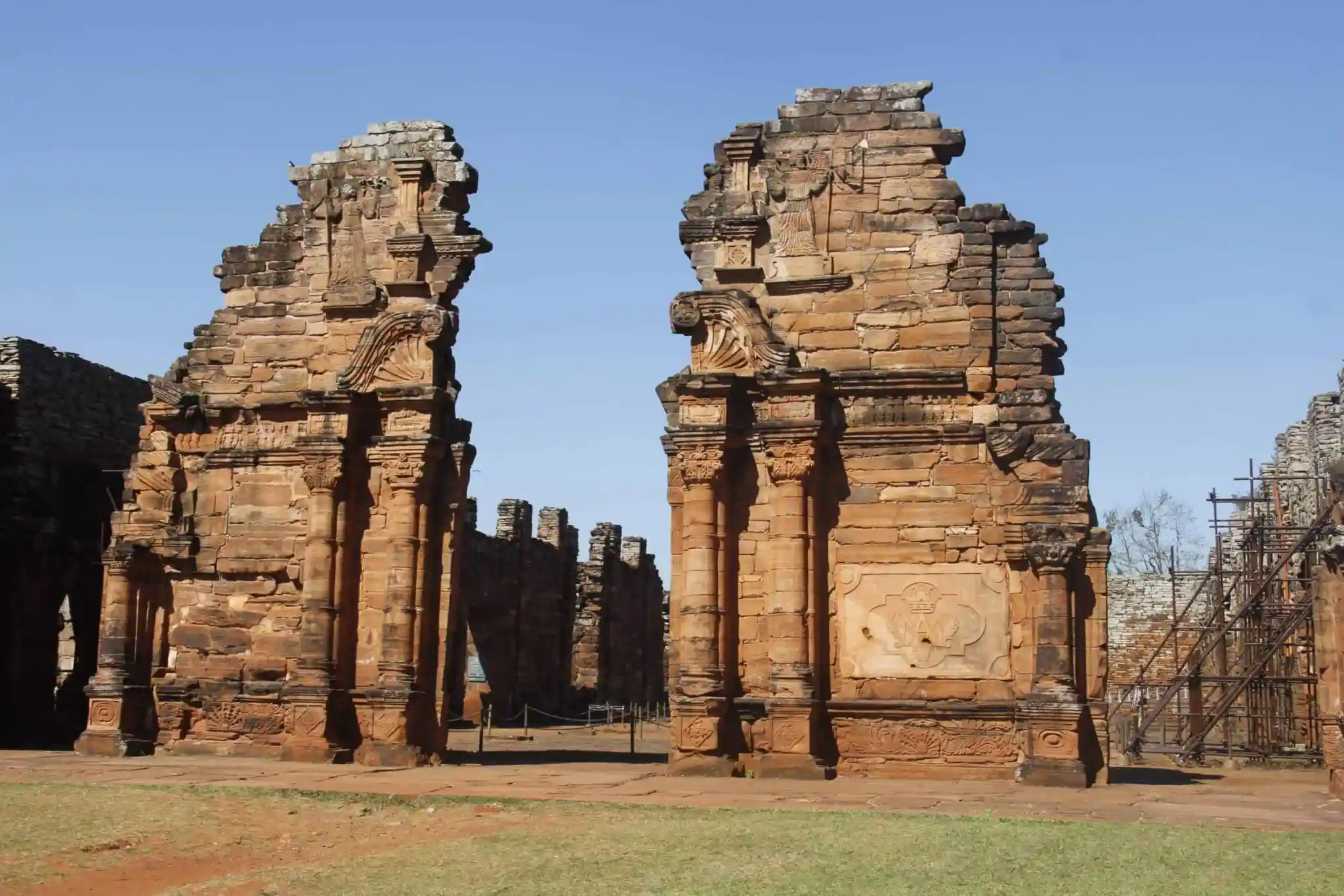
What makes San Ignacio Miní particularly striking is its architecture. Built primarily from local red sandstone, the structures glow warmly under the subtropical sun. The church façade remains the highlight: ornate baroque carvings blend European religious symbolism with indigenous artistic influence.
Angels, floral motifs, and intricate reliefs reveal a fascinating fusion of cultures. Jesuit design met Guaraní craftsmanship, creating a distinct aesthetic that was neither purely European nor entirely indigenous.
The remains of the massive church walls still dominate the site, offering visitors a powerful sense of scale and spiritual grandeur. Even in ruin, the structure commands reverence.
UNESCO Recognition and Regional Significance
In 1984, San Ignacio Miní was recognized as part of the UNESCO World Heritage designation that includes other Jesuit mission sites in the region. Nearby, across the border in Paraguay, the ruins of Jesuit Missions of La Santísima Trinidad de Paraná and Jesús de Tavarangue form part of this shared cultural legacy.
Together, these missions illustrate a remarkable attempt at creating self-sustaining communities based on cooperation, education, and shared faith. Though the Jesuits were expelled from Spanish territories in 1767—leading to the gradual abandonment of the missions—their legacy endures in the stones and stories of San Ignacio.
An Immersive Visitor Experience
Located just an hour from Puerto Iguazú and the world-famous Iguazú Falls, San Ignacio Miní offers travelers a perfect complement to the region’s natural wonders.
The site is beautifully maintained, with informative pathways guiding visitors through the old plaza, church, cemetery, and residential quarters. As the sun begins to set, the red stone deepens in color, and the jungle sounds grow louder—creating a deeply atmospheric experience.
In the evenings, a sound-and-light show brings the ruins to life, narrating the story of the Jesuits and the Guaraní in a dramatic and moving presentation projected onto the ancient walls.
Beyond the Ruins
The town of San Ignacio itself is small and welcoming, offering local crafts, regional cuisine, and access to the broader cultural heritage of Misiones. The province is known for its yerba mate plantations, dense Atlantic rainforest, and historical routes that connect travelers to other Jesuit sites scattered throughout the region.
For those seeking more than scenic beauty—those drawn to stories of cultural exchange, resilience, and spiritual ambition—San Ignacio Miní offers a rare and meaningful journey.
A Place Where Time Stands Still
There is something profoundly moving about standing inside the crumbling walls of San Ignacio Miní. The jungle slowly reclaims what was once a vibrant community, yet the carved stones endure, whispering stories of faith, artistry, and cooperation.
In a world driven by speed and modernity, these ruins invite reflection. They remind us that civilizations rise, flourish, and fade—but their ideas, and their beauty, can remain etched in stone for centuries.
In the red heart of Misiones, history does not feel distant. It feels alive.