


Playadito Takes the Lead: Argentina‘s Yerba Mate Market Sees a Shift in 2025
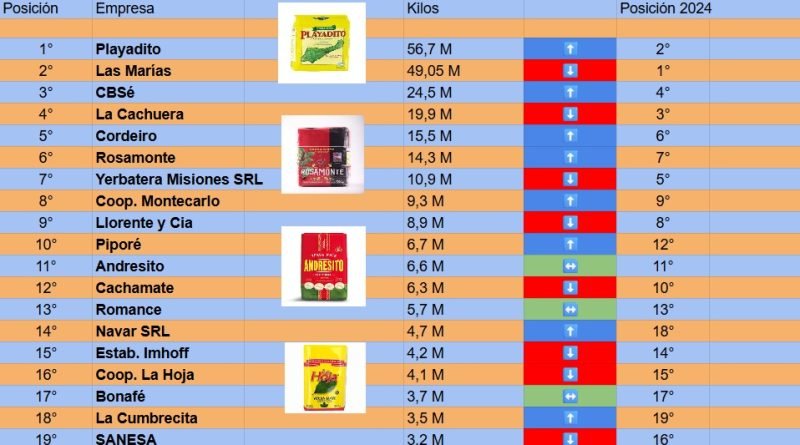
In a significant turn of events within the yerba mate industry, the Cooperativa de Productores de Colonia Liebig, more popularly known by its brand Playadito, claimed the top spot in 2025. The cooperative reported impressive internal market sales, reaching 56.7 million kilos, thereby surpassing its fierce competitor, Las Marías. While Las Marías has long been a powerhouse in Argentina’s yerba mate sector, it finished 2025 in second place with 49.05 million kilos supplied locally.
According to figures obtained from the National Institute of Yerba Mate (INYM), which were shared with the publication Plan B, the remainder of the top ten comprised notable players like CBSé (3rd), La Cachuera (4th), and Cordeiro (5th), among others.
Playadito‘s ascension to the number one spot marks its first successful attempt at outpacing all competitors over a full calendar year. This achievement was bolstered by a remarkable 20% growth in sales compared to the previous year, reflecting the cooperative’s ability to navigate a crowded marketplace.
The winds of change in the industry can be traced back to new regulations instated by Milei’s National Government in December 2023. These changes allowed Playadito to catapult ahead, reaching and reinforcing its leading position by the end of 2024.
The 2025 sales figures highlight the dominance of companies based in the Corrientes province. While Playadito experienced substantial growth, it didn’t cannibalize sales from Las Marías, suggesting a broader market expansion. Together, the two titans accounted for 105.8 million kilos, representing a whopping 36% of the total market, which saw 296 million kilos in total consumption.
Moreover, the Virasoro-based firm Navar SA, with the brand “Primicia,” contributed to the area’s total influence, bringing the combined figure of the three Corrientes companies to 109.9 million kilos.
The rest of the top ten saw CBSé from Córdoba displacing La Cachuera from its podium finish in previous years. Despite this, La Cachuera remains a leader, particularly in exports. Cordeiro, another Córdoba-based company producing Verdeflor, climbed to fifth place, while Rosamonte settled at sixth.
Meanwhile, Yerbatera Misiones SRL, Cooperativa Agrícola Mixta de Montecarlo, and others filled out the rest of the esteemed list, with Llorente and Piporé rounding out the top ten, marking Piporé’s return to prominence.
As Plan B highlights, the competitive landscape has forced yerba mate brands into aggressive selling tactics, which have inadvertently led to pricing pressures throughout the industry. This dynamic not only impacted profit margins but also affected primary producers, despite being celebrated by the national government as a victory for consumers due to lower package prices.
Beyond Playadito, Cordeiro’s Verdeflor brand also enjoyed commendable growth. Due to investments in infrastructure and skilled personnel, Verdeflor recorded a 13% increase in sales, rivaling Playadito in growth velocity.
Companies like Piporé and Romance made notable ascents within the rankings, while others, such as Navar’s Primicia and the innovative Mate Rojo, continued making strides, leveraging influencer endorsements from the likes of Lionel Messi and Franco Colapinto.
Thus, as the yerba mate market undergoes its transformations, it remains a fiercely competitive landscape, with longstanding traditions intertwining with modern marketing strategies to captivate both local and international consumers.
Team V.DIR-EM-UAE